Sweet rot

cornerJust over twenty six years ago, along with most of my family I moved to Adelaide from the town of my birth, Port Lincoln, South Australia. We weren’t in a position to be terribly picky about the kind of accommodation we wound up in, although thankfully the market wasn’t nearly as restrictive as it is today. The place we wound up in was cheap. And a bit nasty.

Our home, then on the corner of Manoora and Wells, was an old fiberboard house that had seen better days. We lived there six months before moving out to make way for for new owners. The land has long since been repurposed, with two modern single story townhouses occupying the space. Suffice to say there’s not much in the way of yard space.

A similar situation has befallen a lot of houses in that suburb; demolished, making way for new brick houses with small eaves and tiny yards. Often two houses are crammed into the space previously occupied by one.

Interspersed between these are some of the remaining, now quite old, fiberboard homes. The locals may have gotten used to it, but it doesn’t take too much effort to smell these old hovels rotting away.

Here and there’s a house that’s been patched up with a Frankenstein’s selection of random boarding, camouflaged unsuccessfully with uniform lashings of paint. Every few streets it seems there’s a vintage car chassis up on bricks. And here and there a new property asserts its McMansionesque vanity with a garish second story.

Winter could be unkind in the older homes. The walls were thin, and the floorboards hovered over crawlspaces the wind could howl under and through.

Nowadays, the wooden supports that held these houses aloft are rotting, and in a rotfew cases have rotted away, leaving homes to sag over the remaining supports. You can imagine kids on Saturday mornings placing balls on the floor to see if they can get them to roll through goals down the other end on the loungeroom.

And I can’t help thinking, if it weren’t for the cold, or the possibility of bad wiring, a good part of me would enjoy living in one of these rancid old abodes again. In an arid city like Adelaide, it’s the closest thing you can get to living in a Louisiana swamp; the closest you’ll ever be to a visit from the Swamp Thing.

Maybe you need to be some kind of redneck for this to have any appeal. Certainly, according to a recent skin examination, I qualify for membership.

Eventually the sweet stench of fermenting real estate will pass, the water stains and the patched up woodwork will be nothing more than memories, and the last redneck of the inner north eastern suburbs will be moved on to more marginal pastures. Lower-middle class aspirants, overworked and underpaid will be crammed into the new confines, with kids, if any, left with little space to play.

The memories are already fading: The Friday night chip shop dinners, and Saturday rental VHS binges still dressed in bedclothes; the last of the NEO GEO arcade games; dropping into the O.G. Book Exchange on the walk home from Klemzig; trying to replicate Keith Floyd dishes off of SBS as a teenager in a rickety kitchen; wanting to try Lumpy’s Pizza and never getting around to it before it was too late.

How many other memories of the area will erode, undocumented, lost to time, unable to be shared? Rotted away along with the last of the prefabs.

~ Bruce

The spokesperson and the punters

A number of years ago I attended a book launch by a local, self-published author with a disability. While I hadn’t known them for very long, being new to local writing communities, I wanted to see what was up, and on some level show support. At this juncture, I was still denying that inner voice that was telling me that something was wrong, and instead telling myself that the odd quirks and signs of passive aggression were not worthy of consideration.

So what? Some people are weird. Artists particularly, right?

Besides, if their work was serious enough to attract an arts grant in the first place, it couldn’t have been all that bad, could it? (Stop laughing.)

Initially I had a little trouble mentally digesting what I saw. Precisely nobody in attendance acted as if anything was untoward. There wasn’t so much as an awkward shuffle in a seat. And if there’s been a word of criticism voiced anywhere by anyone I saw in attendance, it’s been behind doors or somewhere else where us normies aren’t free ranging.

What resulted from this book launch I’d later incorporate, along with other displays of cynicism from local wannabe “activist” artists, into a mental architype of the cynical, neoliberal spokesperson who co-opts progressive language purely for marketing purposes.

“Nobody notices your artifice, or at least, if they do, they don’t want to be the only one who’s calling you on your shit – that’s a one way trip to lonely-town. ”

(‘Tricks in Neoliberal Culture #001: Affirming Values Through Compliments’, 2014)

It’s possibly worth noting that while this piece was well received among a number of friends in the “scene” at the time, aside from those I’ve confided in, all guesses as to who I was talking about have been wrong. People have assumed I was writing about an activist/artist that they just happen to hate. One activist/artist wrongly assumed that I was writing about them – although in that case I’ll take it as a confession. The truth is, the architype was a gestalt of a number of local artists/spokespersons; of both sexes, all middle-to-upper-middle class, all white, and all so incredibly vain.

But back to that book launch.

So, what would you expect from a book written by someone with a given disability, spruiked as the work of someone who was a spokesperson for others with that same disability? What would you expect if the point was made in the lead-up that said spokesperson had lead discussion in focus groups?

You’d expect discussion of the interests of that group of people, right?

Well, the book it turned out, was a memoir, and the perspectives of others with the disability in question – a disability known for its capacity to manifest different symptoms and difficulties from person to person – were completely absent. Moreover, the memoir made it clear that the author was actually living the good life; no economic hardship; good quality of life; excellent prognosis.

What policy exactly would one feel inclined to support after hearing this “advocacy”? Your guess is a good as mine. And probably as good as the guesses of all those folks in the focus groups who’s views weren’t represented in the final product.

Notably, the launch was presided over by a chap from the state government, who praised the author for the high quality of their advocacy work (without providing a single example of said work). You have take a bit of time out to consider what the guy’s interest was in all of this.

Serious advocacy for people with a given disability, by rights, should make people responsible for relevant government services at least a little anxious. Yet the content of the book, and all discussion at the launch, was completely absent of any discussion of government involvement, other than in its role in complimenting the author.

I’m not saying the bureaucrat should have been harangued or abused. There is, for example, no need for activists to call him names or leave a turd in his letterbox. But serious activism is going to raise questions that on some level people like him are going to feel uncomfortable with being raised, if only because it invites consideration of existing efforts.

If all advocacy consisted of such fluff as was on display at the launch – if it were all just solipsistic memoirs from people who are doing fine, actually – government would certainly have a much easier time.

“Hey, we’re cutting back disability services. Could you distract people by talking about what you name your socks again? Thanks! We love your advocacy work! Love, The Government.”

So no, there’s no salacious tale here. Just an anecdote about banal self-regard dressed up as disability activism, and the role and interests of state power in promoting it instead of discussion of actual, material problems.

This is a problem. Tell anyone who’s material issues are being distracted from on account of this kind of thing that it isn’t, and I hope they give you a serve.

Asking around those in more pro-active roles, revealed that it was a given that author was a flake. “Flake” was literally the word used. There was a repeated inference of “why bring it up? It’s so obvious. It’s no secret!”, as if author/spokesperson was a well-known running joke.

This was obviously true. It wasn’t a secret. And it’s not like I expect people to obsess over it either (if I did, I probably would have addressed it more directly, sooner, and then banged on about it ad infinitum).

I can’t fault people for laughing, and then getting on with their lives either.

Only, if you raised this issue with the rank and file members of a number of local writers groups, there’d be gasps, and silence, and people shocked at your audacity, and a whole heap of gossiping about you behind your back. How very well dare you?

Depending on which group you wind up in – some are better than others – you may very well be required to ignore the evidence of your eyes.

“Nothing is wrong! Why, there was even a man from the government saying it was all wonderful! Has a man from the government ever called you wonderful? No! *Sniff*”

There’s no master list of which writing groups to avoid, and arguably there shouldn’t be. But you have to feel, especially for the younger ones, those with a chest full of energy and a head full of good intentions, who go into these things not realizing the nature of the culture they’re immersing themselves into, only for them to find out the hard way.

Meanwhile, the self-regarding, disingenuous sorts remain an almost protected species.

~ Bruce

Polished public figure

A friend and I have just had a brief discussion about a political candidate we’ve had interactions with going back almost a decade – back from before their political career. Said candidate has had a long track record of getting involved with various movements. Although if you went looking for specifics on his views, such as the whys and wherefores of his positions on a range of issues – the kinds of considerations you need to make to actually formulate policy – you’d not actually find much publicly available, if at all.

Bromides. Sentiment. Boilerplate statements. Glib.

Zero scandals. Zero analysis, too.

How does a politician commit when they don’t give you much in the way of details to be committed to? Perhaps when they appear to have a personal stake. Although without the pertinent personal details it’s not really possible to know how true that is, and I don’t want to burrow too far into that side of his life.

At any rate, there’s only a single policy area he’s advocated for that he seems to have a personal stake in. What about all the others?

Maybe – and I’m just putting this out there – maybe on the level of local politics he’s committed himself to things that the rest of the country isn’t privy to. That’s a possibility. But he isn’t running for local council. It’s not unfair to want to scrutinize him in light of a broader context.

Said political candidate became a topic of discussion between friend and I after he weighed in on a controversial topic my friend has been studying at great length. This he did by sharing a memefied bit of rote social justice advice, lavishing superlatives upon the party ally he shared it from. Again, no evidence of consideration or reflection was evident.

Rote. Marketable.

Understandably discussion with my friend didn’t go on for long. There was hardly a surfeit of details to consider.

I haven’t read much of politician’s writing, because to be fair he hasn’t written terribly much. What I have read of it is all motherhood statement and declaration of intent to further certain issues and outlooks – and that (but not how) he will do the job. Oddly enough, he doesn’t further any of these issues themselves in writing. This is odd, because at the very least he’s been willing to write about himself in relation to these issues. You’d think the issues themselves would be relevant.

I once attended a talk he gave. He introduced himself as an activist in relation to a given, loosely-defined movement that had some momentum going at the time. The objectives of the movement were barely referenced, much less discussed at length. He talked about himself and that was more or less the sum of it. Upon reflection, I should have been less charitable at the time.

Digging around for why this guy was even on the stage to begin with didn’t help much. People were impressed with him but I wanted to know why. It turns out that the impressive thing about him was probably his ability for people to be impressed by him. People would literally reference other people being impressed by him, to answer any question of why the guy was impressive to begin with.

It was being impressed all the way down, or at least, if there was something material at the base of this apparent recursion of regard that set the cycle in motion, I couldn’t find it.

But you don’t get the feeling that the guy’s a narcissist, or at least, not the grandiose kind. There’s no imminent doom of him exploding in a fit of rage. Not a snarl, nor a twitch. There’s self-regard, but not terribly much in the way of aggrandizement.

He’s even friendly. But he’s calm. Too calm. Calm when a human should be frustrated or excited just a little. And he doesn’t seem terribly curious, which is odd, because a lot of the people in the demographics he seeks to serve could face an array of potential consequences based on the specifics of the policy areas he’s professed an interest in.

It’s almost as if he doesn’t actually care. It’s almost as if every time he’s made a display of associating with a cause or an organization it’s been nothing more than a branding exercise, and any decision to stick it out (or quietly disassociate) has been purely on the basis of PR.

It’s almost as if there’s nothing to the guy. If not the violence, at least Christian Bale’s line from American Psycho is evoked; “…I am simply not there”.

To infer anything about the guy’s inner political mind, you can’t look to his largely threadbare political statements. There’s just not enough of that to work with. You have to look to the kinds of conversations you know he has to have participated in behind closed doors, and to the decisions he’s made subsequently. In as far as you can infer moral decision making from this, though, in his case you still can’t distinguish morality from marketability; the possibly moral is also the definitely marketable in all cases. Or at least, in all of the cases I’m aware of using the limited privileged information I have available.

He’s clearly had differences with the directions taken by more than one organization he’s been involved with, and has left them in his past with a career-savvy degree of quiet. Not that grandstanding is what the public needs more of, this kind of silence isn’t what you want from a politician either.

If something was morally significant enough for him to part with former allies, some who’ve themselves gone on to campaign with other parties with sitting members, then it relates to differences the electorate are probably interested in. Why is the electorate being denied these discussions? Why is the substance all behind closed doors, rather than in his public declarations?

It wouldn’t be a bad idea for journalists to quiz him on these matters during future election campaigns. “What was the issue that caused you to part with so-and-so, who has themselves gone on to campaign for such-and-such? What will be the most likely sticking point between your party and theirs when it comes to debating this issue?”

This is, of course, if he found his differences with former allies to be morally significant, rather than just promotionally inconvenient. If his past disaffiliations have been PR motivated, then that’d be politically uninteresting. It’d also possibly leave him standing for nothing given how little else he’s actually put out there.

If this guy stands for something, perhaps in a more local context, then his rather enthusiastic supporters need to sell it to more than just the local electorate and their Facebook friends. At the very least it would let us know just a little more about his party. Presumably they’re proud enough of the guy to want to do this, right?

Alternatively, if they can’t do this because there’s nothing to sell, then perhaps they need to realize they’ve bought into a budding personality cult.

~ Bruce

Big waypoint

I’ve been to hospital before, but I’ve never been in surgery. As of writing, I don’t know how this all is going to pan out, but at some point I’m going to have my gut stitched up soon.

I’ve had an umbilical hernia for years and it’s been getting bigger. Occasionally, my intestines are poking through and starting to get caught, which is dangerous. I’m off to see the surgeon tomorrow and I’ll know more afterward.

What I do know, is that the recovery is supposed to be painful. I’m not looking forward to that, but I keep telling myself that the other side of it all is going to be worth it.

Like a lot of other folks with depression, I’m prone to self neglect and this, as in the cases of a lot of other people with depression, has involved my normalizing the aches, pains and reduced function associated with an accumulation of injuries.

One thing that has stood out as conspicuous, despite my normalizing this kind of thing, is my inability to do a single sit-up. Leg raises? Can do them. Crunches? Ditto. A single sit-up? Nope.

I hadn’t noticed until recently that I actually can’t sit up in bed – I roll out in the morning, and I’ve just got used to it. At one point when I was younger, I’d raise my legs, and just bounce from the bed off of my shoulders, landing standing in what felt like one fluid motion. I can’t recall when that stopped but I can’t do it anymore.

I’m not at all sure how much mobility I’m going to get back, but I expect to at least get some. Obviously the extent of improvement will depend largely on exercise post-recovery, but I’ve already got plans for that.

No doubt during my recovery I’m going to want to write more than usual, which of course will be difficult; I’ll be on my back, mostly. I’ve watched more than one YouTube video of an individual post-hernia repair warning against sitting for extended periods.

At the very least, I’m looking forward to removing one of the largest persistent distractions I’ve had in the last six years, even if it does take me out of the game for a little while.

Hoping to see folks on the other side.

~ Bruce

The Bots have always been at war with Eurasia: Paleo poop edition

It’s funny what a benevolent bot will like on Twitter. This time it’s not “social entrepreneur” spam, though.

Welcome to the world of conscientious gastro-blogging.

Mischa takes a pause to consider Conversations In The Kitchen. Sort of the politics-meets-cooking gimmick popularized by Kitchen Cabinet, albeit in book form… and by Alan Jones and Mark Latham.

yeahnah
Yeah nah.

My response was admittedly a tad scatological.

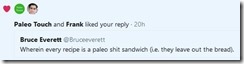
paleoshit“Wherein every recipe is a paleo shit sandwich (i.e. they leave out the bread).”

This time around my comment copped a like from Paleo Touch and Frank – both social media advocates of the Paleo cult diet. Apparently also aficionados of eating poop.

I don’t know which is more Orwellian; the idea that Paleo Touch and Frank provide sound, carefully sourced health advice, or the notion that Alan Jones and Mark Latham are warm enough to speak from the perspective of friendship.

Either way: Don’t eat the food.

~ Bruce

Revisited: Resigning My AFA Membership

Foreword.

I’m pretty sure I haven’t mentioned it on any of my blogs, nor at any great length on social media, but in late 2016 I sent an old fashioned snail mail to the Atheist Foundation of Australia (AFA) withdrawing my membership. Later, in early 2017, not at all to my surprise I was sent an automated email telling me that my membership with the AFA was due for renewal.

As you’d expect, I fired off an email spanning all of three sentences (not including salutatory lines) asking them to read my resignation dated the 5th of December, 2016, and to amend their records. I’ve never liked the idea of resigning after getting into arrears.

The next day I got a reply from Julian Jordan, the AFA’s Treasurer/IT Administrator, apologizing for the renewal notice, informing me that the AFA’s records would be updated, and claiming that my letter did not appear to be received. Julian used the word “appear”, and I think it’s an apt choice of term.

I don’t suspect malice on Julian’s count on this matter. I do suspect he was being truthful in saying he’d never seen the letter. But despite the decline of Australia Post, I’m skeptical of the notion that my letter didn’t make it into the AFA post office box. Unless you’re sending vinyl in the mail, Australia Post aren’t that bad (yet); I was quite meticulous with my handling of the envelope (after having had resignations from/subscriptions with other organizations go “missing” in the past), and I can think of an array of reasons why some people in the AFA wouldn’t want folks reading my letter.

Fast-forward to now, and in recent days, Julian Jordan has commented on a post on a friend’s Facebook timeline, twice threatening to sue them in a manner that at least appears calculated towards leverage; “I may consider taking out a defamation case against you”, “You may be hearing from my lawyers.” [Emphasis mine.] It’s the lingering threat brought about by the ambiguity in the word “may” that makes it look purposed to elicit anxiety; as if Matt is supposed to consider himself at Julian’s mercy in perpetuity, or at least, for the time being. And that’s before taking all the gaslighting into consideration.

So what’s Julian got a bee in his bonnet about? In Inciting Incident podcast #139, Matt (of Iced Coffee fame) quoted an AFA committee member as saying that the accounting at the AFA was “terrible”. Said AFA committee member is named in the thread, and if what they say about the skill of treasury is a poor representation, then that’s not a great thing. I have no idea of how well the AFA’s finances have been handled and I decline to speculate myself, but quoting a committee member’s claims isn’t nearly the same as simply repeating them. This combination of a lingering threat, pompous gasbagging, and the attendant disregard of the use-mention distinction; it reminds me of the threats of legal action made against Julie Posetti in 2010. (But don’t take this as legal advice – I’m not qualified to offer it).

Also, it’s been my observation that this is often the juncture in a defamation complaint where lawyers usually tell their client to shut up and let the warnings and cease and desist letters get delivered under a legal professional’s letterhead. You have to wonder if the perception of trying to leverage someone with a defamation allegation in plain sight of the public would help a person convince a court that their claim was geared towards the redress of damages, rather than, well… other stuff.

I have difficulty abiding this kind of behaviour, and I think it’s best that when it happens, you don’t silence yourself, and instead express something honest and something that the people threatening litigation may not want expressed. So for my part, I’m going to publish the “missing” resignation letter from 2016.

Resignation from the AFA (5th December, 2016)

Dear Atheist Foundation of Australia,

Effective as of receipt, I wish for my membership with the Atheist Foundation of Australia (AFA) to end.

Without wanting to bore either of us with long-winded accounts, I have been aware of complaints concerning the conduct of previous president David Nicholls, and current president Kylie Sturgess. While I have enough information from an array of sources to allow me to form an opinion of either president, and while my sources couldn’t be dismissed as being all hearsay or Internet gossip, these complaints in essence do not form the basis of my resignation – if they were, I would have resigned sooner, or at least would be approaching matters differently now.

Rather, my concerns relate to how a number of committee members and organizers have dealt with these complaints. Specifically in relation to these matters, I’ve been witness to both contradictions between the accounts these parties make, and to these parties contradicting themselves, usually when modifying their story based on who they’re attempting to appeal to or manipulate at any given moment.

Suffice to say I don’t think the truth, whatever either of us thinks that is, is quite that malleable even when one has such an array of interests and personalities to deal with. I’m not in a position to fix any of this, nor do I have the time or inclination to try burning it all down.

In case this doesn’t satisfy peoples’ curiosity, I’ll go on just a little further.

I’m considering becoming politically active again, as I was back before The End of Faith was even a thing. This would likely entail advocacy in an area where I’m supposed to be some kind of para-professional, so I’d at least like to be able to respond to people with a straight face.

Not being a particularly competent liar and given what I’ve seen of how the AFA executive accounts for itself, I’d find explaining why I’m a member of the AFA difficult to couch in compelling terms. Given some of the areas where the AFA presents itself as authoritative are proximal to my para-professional interests (e.g. science, critical thinking and secular education), such explanations would be relevant to colleagues assessing my trustworthiness.

The possibility of discounted tickets to another atheist convention isn’t nearly enough to offset this. It’s a liability I can’t abide.

I find it highly unlikely that the person reading this has no idea of what I’m talking about, but on the off chance this correspondence finds its way into the hands of someone that naïve, I’ll mention two things, then close.

First, when people appear vague in raising these kinds of matters, as I probably do, it’s not always because their concerns are incoherent or ill-conceived. Sometimes they’re not telling you everything they know just to see if you’ll try to fill the void with bulls**t. They’re giving you enough rope to hang yourself. I’d encourage you to use this tactic yourself, as it’s yielded tremendous results for me so many times; Australian secular circles are chock full of bulls**t artists, and mostly gormless ones at that.

This, however, is not the purpose for my brevity.

Another reason people omit details, especially when signing out, is for the obvious reason that it’s so goddamn fekking tedious dealing with bulls**t. On that note, I’ve already seen another AFA organizer given enough rope in the past few weeks via the above method, so I see no need to repeat the trick, as repeatable and comedy-producing as it may be. Nor do I have any desire to receive the same boilerplate condescension dressed up as rationalism I’ve seen served-up to others, so while formal confirmation of my exit would be all nice and dandy, the rest is quite unnecessary, thank you very much.

That’s it. I’m out.

With all due respect,

Bruce Everett

A Few Concluding Words

There’s a degree to which this kind of thing is too self-regarding. I’m certainly not entirely comfortable with posting this (or posts like this) for that very reason.

“I don’t know this guy. Who does he think he is, thinking his resignation matters enough to be published?”

I think I’ll decline this kind of invitation to passivity more often in future. But what’s so special about my resignation anyway? Well, nothing. It doesn’t need to be special in order to be worthy, even if it’s only just a little worthy of being put out there. And really, as far as the AFA is concerned, I don’t have terribly much else to say and I felt compelled to express something under the circumstances.

You don’t believe the complaints in my resignation letter? Want more details? Well fine, don’t believe me. That’s perfectly okay, albeit a bit beside the point.

You don’t always need to have material evidence resolving some point of contention in order to know when someone, or a faction of people, are bullshitting about said point of contention. If they contradict themselves enough, or they as group members contradict each other enough, you know they’re not being straight with you, whatever the truth may be.

If you keep a bullshitter talking long enough they’ll often trip up this way. If they’re canny enough, they’ll realise this and put a sock in it before too long.

Often, that’s enough information to make a decision, even if not entirely revealing.

So instead of hosting some kind of did they / didn’t they inquiry into the AFA, the prospect of which frankly bores me*, I’m just going to commit to continuing to not put up with people who can’t keep their stories straight, and ask that the reader does much the same.

No doubt there’ll be more examples to come, from a variety of sources. This shit’s not in short supply.

~ Bruce

* Which is not to pre-judge others that have an interest in doing so. It’s just I’ve seen enough for my own decision making, and beyond that it’s all supererogatory for me. By all means dig away at it yourself.

Draft manifesto: The No Drama Lit. Group

800px-Stipula_fountain_penPreamble

Two annoyances we may share: Grandiosity in writing groups, and grandiose manifestos. If you’re like me, then you find these things devastatingly de-motivational. You can’t write well with this confected flamboyance echoing around in your braincase.

Histrionic name-dropping, narcissistic limelight stealing, affected wokeness, he-manly pigeon-chesting and over-confident didacticism: who needs that kind of stuff, right?

Now the Internet: It has no shortage of manifestos that are self-important beyond all perspective. You probably don’t want to risk reading just another “Transcendental Black Metal: A Vision of Apocalyptic Humanism”. The publication of yet another Internet manifesto clearly flirts with a well established tradition of bumbledom, banality and pretense.

The following could all just be an attempt at putting out fire with gasoline. Still, I’ll persevere and hope you find this a worthwhile take on treating what ails any number of literary communities: Drama.

The text portion of this post is published under a Creative Commons 4.0 – Attribution-NonCommercial-ShareAlike license. Feel free to adapt for your own non-commercial purposes with reference to this post. (You don’t need to ask first, although I’d be interested if anyone other than myself tried to see this manifesto implemented).

***

The No Drama Manifesto

Purpose

The No Drama literary group is purposed towards the love of reading and writing, and to its candid sharing with similarly disposed human beings. To that end, it seeks to provide its members with a community that allows them to be open without that vulnerability being taken advantage of; a community where quiet confidences and new ideas can be grown and built upon without interruption by undue drama.

Ethos

Environment

1. We’re here for the words. For whatever reason, even if at times the relationship has its ups and downs, we each have a love of the written word. Whether it’s a fetish for fonts, a nose for prose, or a want to reproduce that feeling we had the first time reading an certain author, the writing and the reading are what it’s all about. All other objectives are down-prioritized to varying extents, depending on their capacity to disrupt or serve the functioning of the group.

The No Drama group seeks to facilitate those moments when a piece of writing really clicks, even if those words and the people writing them are ultimately forgotten by history. Posterity into the future should play second fiddle to poetry and prose in the here and now.

2. No Drama. This would be the ideal, at least. Ego-driven entropy may be the driving force behind some forms of art, but it can be utter chaos for a lot of people, and it’s not like there’s a relative shortage of outlets for the ego-driven entropist anyway.

Now sure, keeping the histrionics at bay may itself generate a degree of drama, but consider the refrigerator. Despite it’s name, the refrigerator heats its environment, and yet we still don’t consider refrigerators futile. We use them because there is a useable space kept relatively cool.

Similarly, the No Drama lit group seeks to create a usable space relatively devoid of egocentrism, purposed to the creation and appreciation of literature. That this may cause a small net increase of drama in the wider universe does not invalidate the venture.

Those affirming this manifesto do not accept that writers and bookish sorts are either necessarily or in large part egocentric. Rather, where there is an overabundance of ego, it is largely due to the initial attraction to egoists, and subsequent repellence of more ordinary folks.

3. Comradery. With allowances made for individual meekness, genuflection is discouraged. The least published member will never be expected to simply defer to the most published, and the most published member will be expected not to expect deference. Self-importance should be checked at the door.

4. Respect the work. It’s one thing to throw deference out the window, and another to disrespect hours, or even a lifetime’s worth of work undertaken in good faith. A bachelor of arts and a cursory reading of fad diet materials isn’t sufficient grounding from which to lecture a biologist on their writings on daily protein requirements. An overconfidence in one’s own rationality and a prejudicial dismissal of the literature is no basis from which to critically engage with well-read feminists on feminist texts. This isn’t simply the absence of deference; this is the presence of arrogance. The message is this: Don’t genuflect to individuals, but do respect real efforts made in good faith.

5. Friendly, but with boundaries. Ask yourself; have you ever been in a public space along with any number of strangers, looked around and then felt any kind of general affection for humanity? If so, would you have there and then, on the basis of that affection, agreed to let those strangers just walk into your home, or use your bed, or watch you shower? “Yes” and “no” respectively? Being well disposed towards others does not require you to surrender your privacy or your private life.

Personal boundaries and personal preferences aren’t something you ever have to apologize for, and the context of a reading or writing group is no exception. You don’t have to date other members. You don’t have to invite them to your birthday. You don’t have to become their friend on social media. That’s your own business, not the group’s.

6. Critique is crucial. Some writing groups ban criticism. This is sometimes done in a potentially misguided attempt to stave off abuse, which is itself a serious but ultimately separate matter. Elsewhere it’s done so as not to alienate those with poor confidence, even when it isn’t at all clear that criticism is scaring people off in the first place. Not everyone has a full creative sense of self at all times, and friendly criticism provides information a writer can use to re-orient themselves. Group members should aspire to accept criticism in good faith, and to provide quality critique themselves. Good critique is usable critique, and the process of justifying your writing decisions, even if only to a friendly audience, will help make you a better writer.

7. Editorial should be independent. What information a critic gives can be used by a writer as they see fit. Being open to criticism does not obligate a writer to simply obey their critic. Unless you have a contract wherein you’re actually someone’s editor or publisher, you don’t have a modicum of authority over what they write. Furthermore, should the group create its own publication, content should be keep editorially independent from committee, with the editor aiming to facilitate the free expression of group members in accordance with civil, democratic principles.

8. Professionalism. While not every member will be a professional writer or critic, some basic professional standards should still apply. Intellectual property rights, whatever the licensing details, should be respected. Plagiarism should be subject to a policy of zero tolerance. Membership in professional organizations, where possible, should be encouraged.

Training provided by the group needn’t be vocational, nor necessarily certified – people can learn simply for the sake of learning – but it should be provided by competent trainers with at least some meaningful background in the content being taught. Having a layperson turn up to a WordPress tutorial with the understanding that they can brush up on their CSS, only to find that the trainer doesn’t even know what CSS is, and has only six months experience with WordPress using it to sell herbal supplements, is not the kind of outcome the group should allow.

Exclusions

9. Welcoming, but not self-annihilating so. The word “inclusivity” has to some extent been fetishized beyond the point of its intended meaning, into an absurd and impossible categorical imperative.

If for example, you want your group to be inclusive of victims of domestic violence, then to some extent you’ve going to have to exclude domestic abusers. The logic at base is this: It’s an unavoidable truth that humans have conflicts of interests, and to be inclusive of any group of humans you may at some point have to exclude others. The point is not that you should be universally inclusive, but rather that you don’t exclude people arbitrarily.

Within reason, know what you want or need to exclude, why, and be open about it.

10. Not here to make you famous. Maybe you’ll make it big, but it won’t be because the group tried to make it happen. A love of writing is not the same thing as a love of celebrity, and a writing group that prides itself on its part in raising a member’s stature is a group that potentially does so at the expense of emphasizing the writing.

11. Not here to help make you an activist, per se. This isn’t to disparage activism, but rather to be clear about objectives. A lot of writers try their hands at activism. Writing obviously can be a means to an activist end, and there’s nothing wrong with that. But for reasons that should regarded as axiomatic, writing is in and of itself what a writing group is primarily about; it’s in the name.

Further, it’s cynical, if not pathological, to treat activism as a means to service one’s own status as a writer. Even though activism is not the group’s purpose, the group should not want to see worthy causes selfishly co-opted. Whether writing or activism is an individual member’s greater passion, all members should find hypocrisy in regards to either repugnant. Further, this brand of hypocrisy counts as drama.

12. Not here to help you push product. No multi-level marketing will be allowed.

13. Not here to help you harass. This should be a no-brainer, but abuse should not be tolerated at all and should be stamped out fast. If for example a victim of domestic violence joins your group, their abuser should not be able to follow them by joining. Leniency should not be afforded to abusers on the basis of their perceived righteousness – self-righteousness typically having a capacity to motivate and rationalize some of the worst behaviour humans are capable of. The No Drama group is not a “hunting ground” – members who use it as a means to follow others home, or sexually harass, should be kicked out in short order.

Governance

14. Committee work is a duty. The idea of committee work and in particular the politics surrounding it may fill people with varying proportions of awe and dread. But in many cases it’s necessary – depending on context, membership in umbrella groups, paperwork for grants applications and so on may require incorporation, which in turn will require a constitution, and a committee and so on.

So how to prevent too much drama in committee work? A lot of it comes down to how the group views itself and the purpose of its committee. Respect for the office of committee member, and for the executive decisions of committee are a must, but this needs to be counterbalanced. Committee needs to deserve this respect. Committee needs to not overreach, and a culture of reverence must be avoided. Committee members need to be viewed by normal members as being peers performing a few extra duties.

A good committee serves its members and isn’t be there for prestige or advancement.

14. Democratic. After the initial start up period, committee should be elected annually and held accountable by the membership. The membership must not be willfully kept ignorant of the state of the group’s operations. Committee must take reasonable steps to ensure the membership is kept apprised of policy formulation in a timely fashion. The group’s constitution should be published online, made available to members on request via email, and ideally a copy should be brought to all meetings by a nominated committee member.

15. Try before you buy. Prospective members should have to attend a small number of ordinary meetings before they can join as full members, and should only be able to attend a small number of meetings more before they have to become full members. This way both the group and the prospective member can get to know one another before any monies potentially change hands, and a degree of freedom to part ways exists prior to any party feeling overly obligated.

16. Minimalist. Committee, in addition to not editorializing in any of the group’s publications, does not have authority over the content of literature discussed within the group. While individual committee members can participate as ordinary participants, no act of committee should select a book for a reading group. No act of committee can tell a member what to write about.

Creative decisions on collective activities (e.g. themes for writing competitions) must come from the ordinary membership, with committee deferring to, recording and acting upon these decisions. Committee can only reject such decisions on legal grounds, or when they transgress the No Drama ethos, with any disagreements to be raised for discussion at annual elections.

Committee must restrict itself to the practical functions of running a lit. group, plus the duties inferred by the No Drama ethos.

Contact

If you want to keep me up to date on any attempt to implement the above, or you wish to discuss further efforts towards a final draft, or you’re interested in helping establish a No Drama group in Adelaide, feel free to send me an email at:

contact
Photo Source:
CC BY-SA 3.0 Antonio Litterio, 2011.

The Pledge

If you’ve been around political, quasi-political, or life-stance groups for long enough, especially secular or left-ish communities, you’ve seen more than one wave of acrid disagreement; “The Clusterfuck”, “Elevatorgate”, any number of demarcation disputes, internal disputes among allied Radfems, various fronts of The Culture Wars, etc., ad nauseam.

A lot of the time, at least in the initial dispute, you’ve found yourself arguing at odds with someone who’s a genuine asshole (e.g. Gamergaters). Afterward, you’ll possibly find yourself among more principled people, albeit ones you don’t necessarily know so well. Perhaps in the glow of finding new allies, you’ll embrace them too – perhaps a little too closely.

If you’re actually serious about your beliefs and your ethical inquiry, some of your friendships will at some point still be pushed beyond breaking point. And to be clear, I’m talking about friendships with more principled types – not the trolls or abusers.

You can’t be friends with everyone forever, even the kinder, more considerate types. Reality isn’t that romantic. There are too many dimensions in politics for you to agree on all of them with terribly many people, and some of those disagreements will be the shits.

This is sad, but I think people need to be more accepting of the fact.

So this would be the first clause of a pledge I’d like people to take: The acceptance that yes, even among caring, honest, principled people, friendships can be casualties, and this is okay. Everything comes to an end, and amity is no different.

If you’re a political type, look around your immediate social circle; none of these people are guaranteed to be your friends forever. Try not to be jealous or possessive – you don’t own these people. Why hold them captive? Why allow yourself to be held captive in an increasingly strained friendship? Why should any of you be so taken for granted that you’d be expected to agree to the details and significance of every single political detail to the nth degree anyway?

And why would political marriages be magically immune to divorce when normal ones aren’t? It ends: Accept it.

Because this is sad, a second clause: Allow yourself to grieve for these lost friendships, ideally as soon as it becomes clear it’s all heading that way. Grieve as much as you need, but try to do as much of it as you can up-front so it doesn’t fester.

You’re going to meet new people. Perhaps you’ll fall out with them too. It happens. It’s to some extent a cycle.

Taking your values seriously comes at a cost. If you aren’t feeling that cost, then perhaps it’s because your values aren’t being tested, or perhaps it’s because they’re too cheap to cost you anything to begin with. No? It still hurts? Congratulations – you’re not a nihilist.

The third and final clause: While accepting that friendships end, allow yourself some dignity in how that happens. Do everyone a favour; don’t end it all in spite or vex. Purposely unravel your alliance or friendship. Allow it to be bittersweet, but realize that however righteous your cause, it’s not going to be served by prioritizing vengeance, nor will construing the first possible morsel of evidence as proof absolute of malicious intent advance your objects.

And again, these are the better kinds of former friends and allies we’re talking about here, not inhuman monsters.

I suspect a lot of wonks and activists try to distract themselves from the disappointment and sadness of a political friendship ending, and if they can’t do that, then a lot of them try to externalize blame – even when there’s none to apportion. Why? Because if they blame themselves, and they can’t find forgiveness, it could very well weigh on them heavily.

But this kind of self-pity is selfish and there’s another option – accept and take responsibility for your emotions. You’re allowed to be sad, but it doesn’t entitle you to terribly much. Cry if you have to. It’s allowed. Guide yourself through that pain and try to articulate the reason for the end of your friendship, even if only to yourself.

Use this information. If your disagreement was worth enough to end a friendship, then the details are worth further reflection at some point.

Codify your disagreement. Get it inscribed into the minutes if you have to. Someone may learn from it further down the track, and if you’re not being vexatious it’ll be easier for good people to pay attention when that day comes.

You don’t have to tell them you told them so, but you can tell them.

It may be too much to expect you both to at least respect each other above and beyond the basic package, granted. If your views on humanity turn out to be too antithetical – or even just appear that way due to the narcissism of small differences – then a begrudging respect may very well be impossible.

Unless you’re at war though, or unless someone’s committed a crime. Unless there’s an actual victim at the base of your disappointment awaiting liberation by your hand, then you should be able to manage something along the lines of a cool co-existence in whatever domains you’re left sharing with your former friend.

***

So here’s the pledge again – perhaps you could mutually agree to it with a friend today: Accept that political friendships can end. Allow them to end when it’s clear they will and allow yourself to grieve their passing. Work through your grief without vex or spite, towards an purposeful articulation of your political disagreement.

I hope you find this fruitful.

~ Bruce

A day at the Ed Castle: Churches of Steel II – a few highlights

As a part of an ongoing campaign to weather away at my hobo status, I head out to Churches of Steel II on the 3rd at the Ed Castle Hotel. For those not in the know, Churches of Steel is a metal festival here in Adelaide featuring mostly Australian metal acts. Honestly, I can’t remember the last time I went to a music festival (have I ever?) and they do tend to remind me of conventions which I’ve never been big on. But what the fuck, you’ve got to get your ass out and about some of the time, right?

***

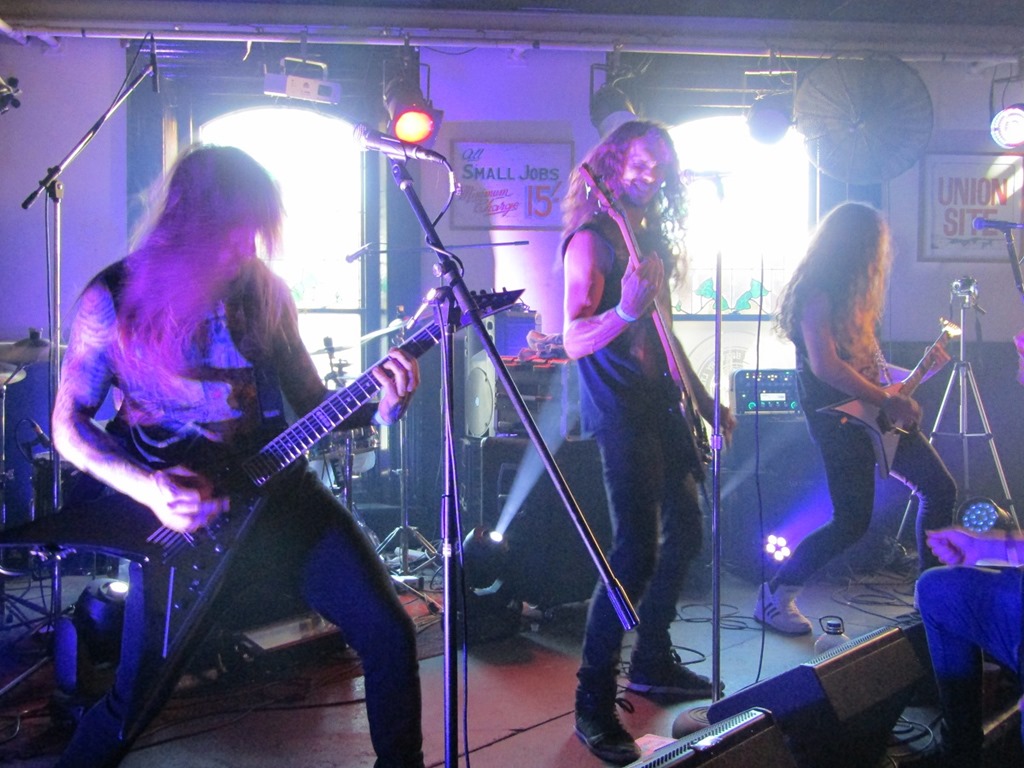
Fortunately I wasn’t fashionably late enough to miss the sludgy doom of slovSloven who were up first. Sloven, while blasting out growls you’d expect to hear echoing down from a Scandinavian mountain, got me thinking about a few things. First of all, was how friends with a few years under the belt have been recounting how non-narcotic things they associate with past drug use have been giving them a buzz in the here and now. Sloven just happened to give me a buzz that reminded me of this, which no, is not a confession. (Although call me paranoid, I did later opt to avoid Adelaide Train Station and the potential of sniffer dogs on account of a nutty smell in the beer garden).

The other thing is… well, Jesus fuck, doesn’t Sloven just know how to work distortion? (The answer would be “yes, they do”). Adam Neely has had some interesting things to say about psychoacoustics on his YouTube channel (here for example) that I’ve been watching lately, so subsequently, I was wondering just how much Sloven take advantage of this kind of thing to fuck with people’s heads. That and how and why a number of metal bands seem to sound so much better live than over the radio. Thank you Sloven, you’ve helped me be more neurotic.

execAfterward out on the beer garden stage came the fun of Executus’ brand of blackened thrash. I thought I picked up on geek vibes from these guys, but not in a bad way. The icosahedron on the cover of their Escape Reality EP is a bit of a give away, but fortunately there wasn’t so much as a whiff of Mountain Dew or Hot Pockets in attendance. When I say Executus are fun, it’s because they don’t take themselves too seriously all while still managing not to undermine themselves with facetiousness. This isn’t always an easy balance to manage, and it allows an audience to goof off without being reduced to clownhood.

Years of trying to like Nuclear Assault has taught me that you don’t want to spend your time being relentlessly serious when it comes to thrash.

***

Anyway, it was really fucking nice under the tree out in the beer garden, so much so that I ended up sitting-out Dirty Pagans who were on-stage inside after Executus. All due credit to the organizers, and to the Ed Castle, by the way – landing such a decent venue on short notice after the Producers closed down was an awesome win.

***

Hailing from Sydney, Lethal Vendetta followed out in the beer garden. Hearinglethal them cranking out Liar’s Dice was grounding – Brent Logan’s vocals are so fucking old school, and wouldn’t have sounded at all out of place next to the likes of Bezerker, blasting out over community radio back in 1990.

I missed Bezerker live as a kid, moving to Adelaide just after they’d moved to the UK to try their luck there, and just as local thrash started to wind down during the ascension of grunge. Seeing and hearing Lethal Vendetta live in their own time – now – kind of makes up for some of that in a weird way, which I’m grateful for. Thanks guys.

jimSpeaking of old school, and missing out, I feel like a bit of a dope for not being around the scene when The Loving Tongue began its evolution. Largely to dodge a couple of scary women with knife fetishes, but also to wallow in the darkest, bleakest black metal I could find – which admittedly wasn’t very dark – I started to avoid mid-1990s venues like Cartoons on Hindley Street, which really, I shouldn’t have.

Fortunately Jim got the band back together for a live appearance to the benefit of those of us not smart or fortunate enough to be there the first time around. I’ve only seen Jim on stage twice, and both times he’s been at the helm cranking out an awesome cover – this time we were delivered some Dio, which rocked. If Rino was around, maybe we’d have gotten KISS. It’s near-on impossible to get your hands on a Loving Tongue album these days, so if you ever see any you don’t already have sitting on a merch table somewhere, do yourself a favour before it’s too late.

It should also be mentioned that Big Tom has got a blues infused project of his own (which I really need to get around to seeing). He’s got a gig going on down a bit southward this Sunday, which I’ll be kicking myself for missing.

***

Things got a little confusing in the early evening. Unfortunately Matterhorn didn’t perform owing to illness. I was looking forward to seeing them live having thus far only heard their covers played on DDD Radio, and recently finding out they’d started performing their own material. These things can’t be avoided, so I’ll wait for another time.

asylumThe first real big shock of the night though, was Brisbane’s Asylum. I mean, Jesus fucking Christ. Let me put it this way – imagine seeing a band for the first time that manages to play old school thrash without being derivative, who make you feel almost the same way you did when you were a kid the first time listening to Kreator’s Extreme Aggression. And clearly, most everyone else felt something similar: the crowd went off.

(Apologies if you weren’t a kid when Extreme Aggression came out, but you probably still get the gist).

Maybe it’s because I’m not familiar with their body of work, but I couldn’t spot a fuck-up either. Either way their performance was tight, and for the first time in the night I was wondering how the fuck anyone else would follow, and we were only half way through the card. I’m not sure anyone did top Asylum’s performance, and everyone who came afterward earn points just for guts.

“Okay, you can all go home now. Metal is finished.” – My brain after Asylum for the first time.

***

If you can’t out-thrash them, out-Viking them? Brisbane’s Valhaloreval were not what I was expecting. Often Viking metal comes in two general forms; super-serious-folk, sub-Wagnerian, crypto-Nietzschean, Viking metal, and clown-arse Viking metal. Valhalore were neither.

Valhalore did manage to straddle that difficult divide between over-seriousness and the absurd that Executus deftly managed earlier in the night, resulting in something festive and more mead-than-blood-soaked. How many folk/Viking metal bands can you think of that could break into a jig onstage without making a fool out of themselves?

Still, I’m a grumpy, overly-serious kind of old fart who’s been marinated in Bathory for too long, so when I’m told to grab the nearest person to me and dance, I still kind of want to reach for an axe instead. It’s a learning curve I guess.

hiddenNow, if there’s anyone who held a candle to Asylum on the night, in my opinion it was Hidden Intent. They were pretty much as tight as Asylum, and the crowd went wild for them. Of course, people were wound up by that point, and Hidden Intent had the home ground advantage. The sheer shock of hearing Asylum for the first time was a confounding factor too. It’s hard to call and I’m not sure I’m competent to call it, so I’m not going to. Being unable to tell who gave the most awesome performance on a given night is precisely the kind of problem you want to have at these things, so I’ll not complain.

Now I just need to get my shit together and get my hands on a CD of Fear, Prey, Demise at some point in the near future.

Another grounding moment came with Vanishing Point – the amount of times Ivanishing reckon I’ve heard When Truth Lies on DDD Radio is probably less that I actually have, but it’s been stuck in my head and it was welcome familiar territory, coming after a day of hearing songs that for the most part I’d never heard before. When there’s this much chaos, you need these kinds of familiar sign posts to remind some of the older audience members of just what planet they’re on.

Vanishing Point were, as expected, precise in their execution of pretty much everything they did. But by this point I was really starting to wonder about the heat in the joint. I wasn’t feeling it, but I’ve been told the Ed Castle gets hot, and when a vocalist takes a towel to a guitarist’s head mid-solo, you’re reminded of this. You have to wonder how Melbournians feel this stuff when they head up here, not that it made Vanishing Point miss a beat.

***

lichAnd then there was Lich King from the US, bane of my eardrums (which copped a bashing from the speaker a couple of feet to the left of my head). Asylum got an acknowledgement for blowing Lich King away, but if that gave Lich King nerves they weren’t showing it. It’s a bit hard trying to decipher how much competition is going on here between the bands – friendly, obviously – and how much is straight up camaraderie. You know they like playing the same gigs, but are there hidden stakes; beer tabs, dares and running bets?

I’m still trying to make my mind up about a thing or two about Lich King. They made with more of the swaggering braggadocio than other bands on the night, and by the end of their set when people started chanting “Black Metal Sucks”,  something was niggling at the back of my head (which had nothing to do with me wearing a Bathory t-shirt, honest).

I suspect a meaningful difference between Lich King and their Australian counterparts on the night probably comes down to the difference between the piss-take and the roast. The American tradition of the comedy roast doesn’t really have a counterpart in the rest of the Anglophonic world – the piss-take is as close as it gets. While the roast is dry and direct by design, the piss-take is considerably more amiable with much more nudging and and winking. Canadians, New Zealanders and the British all veer towards the piss-take as well – consider Canadian Steve Terreberry’s “How To Be Black Metal!” as an example; it’s not a roast, it’s a piss-take, but touches on pretty much all the same points as the considerably more overt lyrics to Lich King’s Black Metal Sucks.

While Lich King are clearly perfectly capable of laughing at themselves, I reckon there’s a real difference there, and that it’s probably cultural – although it will take more gigs and more listening to be sure. All the more reason for these kinds of festivals, and from what I’ve been led to believe, Adelaide’s probably going to get a Churches of Steel III and IV.

I’ll be looking forward to it.

~ Bruce

First gig of 2018: A night at the Ed Castle

EdLast Friday, the 5th, I spent a warm January night dropping in on a gig at the Ed Castle. Voros were headlining, supported by Biome, I, Protagonist and Meth Leppard. A friend in I, Protagonist had asked me along, I had a book I’d wanted to give him, and I needed to get a bit more familiar with how my new camera handled the dark. Ultimately though, I’d only be able hang around for the support acts.

***

Biome were first cab off the rank, starting off by mixing in what was either Tuvan or Tibetan throat singing with reggae, jazzy bits and death metal. It worked pretty much seamlessly.

I’ve never had a problem with women growling on lead vocals, but I’ve occasionally wondered if market forces don’t tend to commodify and tropify female death metal leads – moreso than males – in the direction of musical cliche and the predictable throwing of shapes.  Fortunately Biome’s vocalist, Jo, showed no signs of any of that. Her vocals were unaffected and her stage presence was that of a person seemingly happy wearing their own skin.

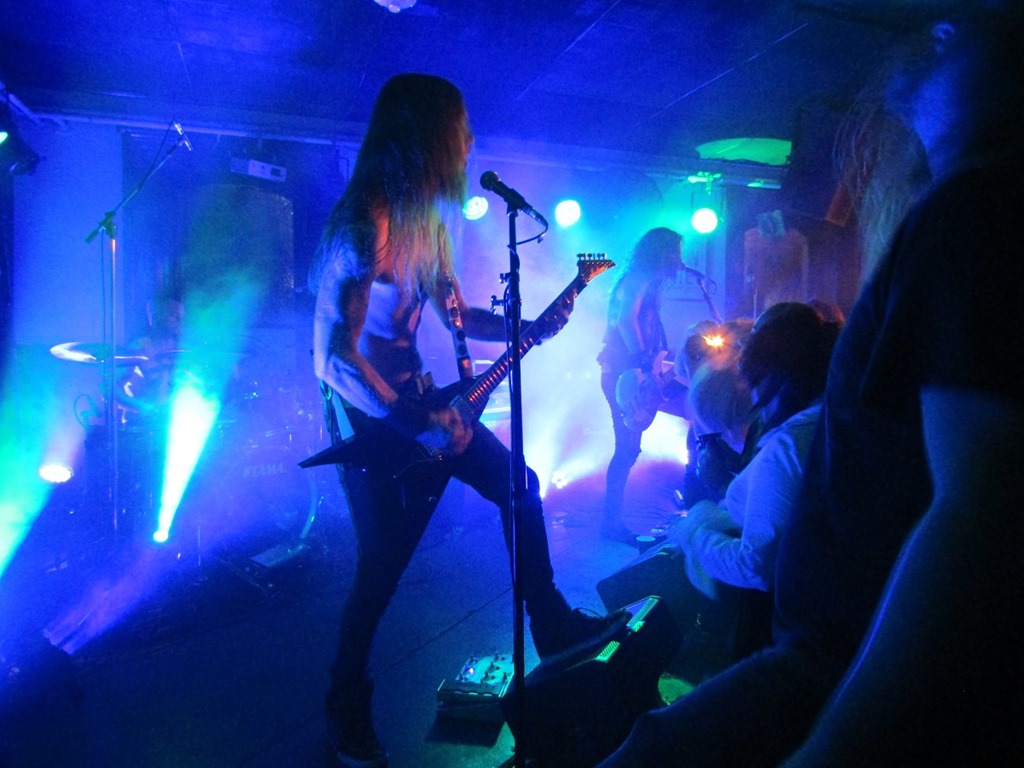
I wasn’t able to get up closer for a snap, and the lighting had possibly drenched the stage a bit too red for my camera’s liking. But maybe it was safer I’d hung back anyway: The stage looked like a scene from Stephen King’s Carrie – if Carrie had been possessed by Pazuzu.

(Also, judging by the bassist’s moustache, there may have been pirates).

People have told me this was Biome’s first outing, although I’m not sure of the truth of the matter. If this is just the beginning for them, I hope the industry affords them the ability to keep on doing their own thing – especially if one day they get signed by a label. You can check out their stuff for yourself here.

***

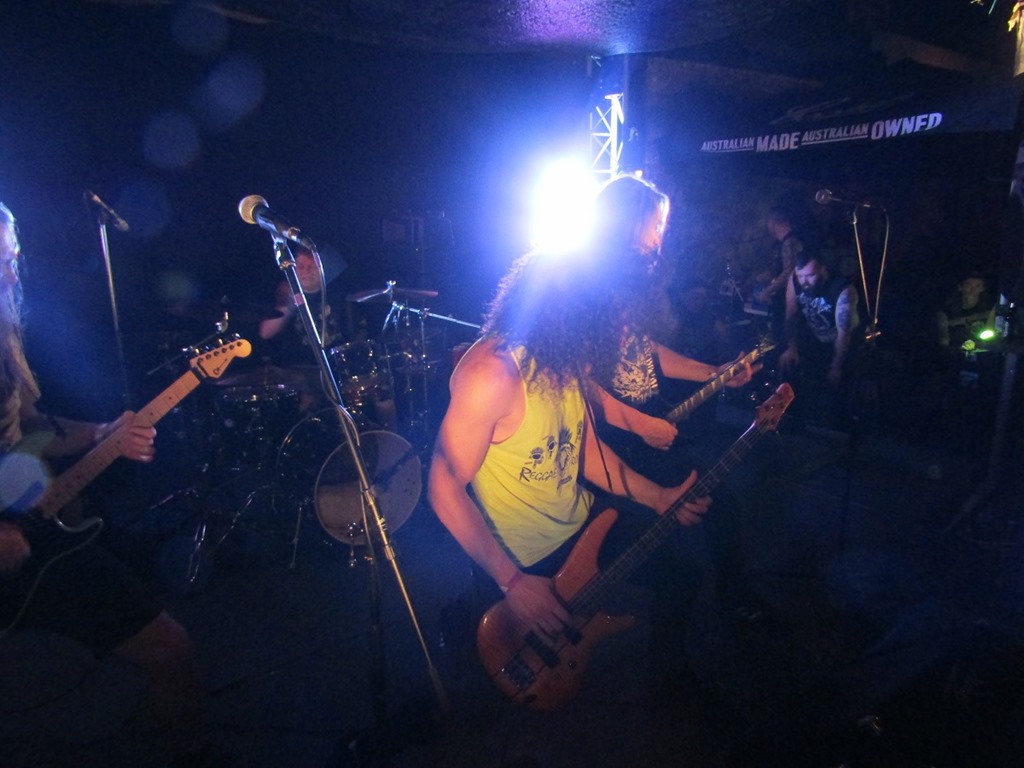
I ProtagonistNext up were I, Protagonist, who cranked out a few memorable numbers with a dual vocal attack, between fits of making ears bleed. “Sober Dionysian” is a track I’ll probably reference as a starting off point for a future discussion of the Apollonian and Dionysian. A new track, “The map and the territory” was chunky in all the right places, but apparently the drummer made a mistake during the performance. I can’t say I noticed.

I was able get a bit closer this time, and from that vantage point it looked like the crowd were keeping their distance. Maybe they were worried Scott would tread on them, what with all the stomping back and forwards. Or maybe they didn’t like his The Smiths t-shirt (“eww, Morrissey”).  How he didn’t put a foot through a foldback speaker I have no idea.

You can get a hold of some I, Protagonist online here.

A Scripted Oblivion

A Scripted Oblivion CD: $5 from the merch table at reputable watering holes.

***

Meth LeppardAfter a short change, Meth Leppard followed.

My camera managed to get a single clear(ish) shot towards the end of the sound check. The rest of the time getting a clear shot of the drummer would have been like trying to take a picture of a hummingbird’s wing – he was all over that kit.

I’m not overly familiar with Meth Leppard, and maybe my ears were just fucked by this point, but I was hoping to hear some Krokodil Dundee in there and I’m pretty sure it didn’t happen. All the same, you’ve gotta love a band with a name like Meth Leppard who then follow through with a title like “Krokodil Dundee”; worth a check-in on that basis alone.

Grindcore, like other “core”s, isn’t really my thing, but I’m finding I feel it live a lot more than when I listen to it at home. Meth Leppard are no exception, so maybe I’ll have to keep my eyes open for more of them in future.

Meth Leppard can be found dealing their seedy wares on Bandcamp here.

***

Being soft and all, I had to head home before Voros hit the stage. It’s okay if you think I suck for that. I’ll probably have to start doing a little more homework on them in the near future (i.e. listening to them more intently).

Their latest album is available on Bandcamp here.

***

So that was it for the Ed Castle. Or so I thought. I’d only just bought my ticket to February’s Churches of Steel II, when it was announced that the event would be relocating to The Ed Castle after The Producers had closed.

churches

This’ll be an interesting addition to the ticket collection.

The older tickets to The Producers will be honored at the new venue, and the two stages will be maintained; one of them in the beer garden. Sweet.

I’ve also paid up for Overkill and Destruction’s gigs at Fowlers in the first half of 2018. Not having gotten out to nearly enough gigs over the years, I’m contemplating seeing if I can get along to see Venom Inc. at The Enigma Bar too. There’s also Heavy S.A. to consider in April, and it looks like Biome are on the lineup.

Either way, when the time comes I’ll be writing up some proper gig reviews around here.

~ Bruce